


How AI-Assisted Medical Record Review Supports Complex Legal Cases
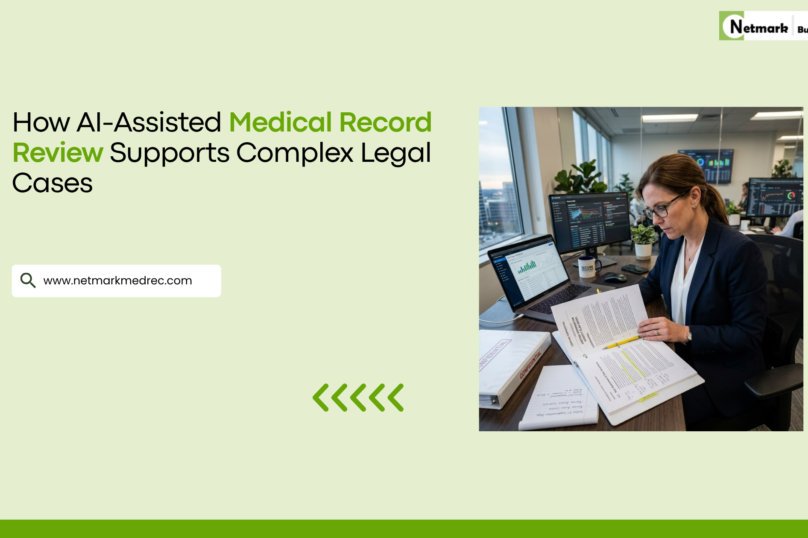
When a legal case involves thousands of pages of medical records, the challenge is not simply finding information—it is finding the right information at the right time. Attorneys may need to understand years of diagnoses, treatments, medications, hospitalizations, test results, and provider notes before they can build a strong case.
AI-assisted medical record review can help legal teams manage this complexity more efficiently. By combining technology with professional human review, law firms can organize large volumes of records, identify relevant information, and develop clearer insights without treating artificial intelligence as a replacement for legal or clinical judgment.
What Is Medical Record Review?
Medical record review is a detailed examination of a patient’s medical documentation to identify information relevant to a legal matter. A reviewer may analyze physician notes, hospital records, diagnostic reports, medication histories, laboratory results, nursing documentation, and other healthcare records.
The purpose is usually to understand the medical facts, identify important events, detect inconsistencies or gaps, and connect medical information to the legal issues being investigated.
For attorneys, medical record review can answer questions such as:
What happened to the patient and when?
What treatment was provided?
Were there changes in the patient’s condition?
Are there documentation gaps or inconsistencies?
Which records are most relevant to the case?
What issues may require further review by a medical expert?
AI-assisted technology can support this process by helping identify dates, medical events, diagnoses, medications, and other potentially relevant information across large record sets.
What Is Medical Record Summarization?
Medical record summarization takes the information identified during review and presents it in a concise, organized format. Instead of requiring an attorney to read hundreds or thousands of pages, a summary can provide a structured overview of important medical events and developments.
A summary may include a chronological timeline, significant diagnoses, treatments, procedures, hospitalizations, and other case-relevant information.
The distinction is important: medical record review is broader and investigative, while medical record summarization focuses on communicating key findings clearly and efficiently.
Key Differences Between Review and Summarization
Although the services work well together, they serve different purposes.
Scope: Medical record review examines the records in greater depth to identify relevant facts, relationships, inconsistencies, and potential issues. Summarization condenses those findings into a more accessible format.
Methodology: AI-assisted review may use technology to search, categorize, and identify patterns within large record collections. Human reviewers then evaluate the information and its context. Summarization organizes verified findings into a concise narrative or timeline.
Outcome: The outcome of a review is a deeper understanding of the medical documentation. A summary provides an easier-to-consume reference that attorneys and other case professionals can use.
Time and cost: Automating repetitive information-identification tasks can reduce the amount of manual effort involved in reviewing extensive records. However, efficiency should not come at the expense of accuracy. Human validation remains essential, particularly in complex cases.
When Should Attorneys Use Each Service?
Different stages of litigation may call for different approaches.
During discovery: Medical record review can help attorneys identify relevant documents and understand the medical history before developing discovery strategies.
Before trial: A concise medical record summary can help attorneys quickly revisit major events, prepare witnesses, and organize questions for depositions or trial.
For electronically stored information (ESI): When medical information is included within large electronic collections, AI-assisted tools can help identify potentially relevant documents and information for closer examination.
When engaging experts: A well-organized medical record review or summary can give medical experts a clearer starting point for evaluating the facts and forming professional opinions.
Practical Benefits—and Potential Pitfalls
- AI-assisted medical record review can provide several practical benefits:
- Faster identification of relevant medical events
- Better organization of large record collections
- Easier access to important dates and documentation
- Reduced time spent on repetitive searching
- More efficient collaboration between attorneys, reviewers, and experts
The technology also has limitations. AI systems can misinterpret context, overlook subtle details, or incorrectly identify information as relevant. Medical terminology can be complex, and a single statement may have different significance depending on the surrounding documentation.
For this reason, AI-generated findings should be reviewed and validated by qualified professionals. AI should support the legal team’s workflow—not replace professional judgment.
How to Select a Medical Record Review Provider
Choosing the right provider is critical, particularly for complex litigation. Law firms should ask:
- Does the provider have experience with legal medical record review?
- Are qualified human reviewers involved?
- How is AI-generated information validated?
- Can the provider handle large and complex record sets?
- What security and confidentiality measures are in place?
- Can the provider meet case-specific deadlines?
- What service-level agreements (SLAs) are offered for turnaround time and quality?
- Can reports and summaries be customized to attorney requirements?
A provider should be able to explain its workflow clearly rather than simply promoting AI as a standalone solution.
Integrating AI-Assisted Review Into a Law Firm Workflow
The most effective approach is usually a collaborative one. Start by defining the legal questions the review needs to answer. Provide the reviewer with relevant case context and identify critical deadlines.
Technology can then help process and organize the records, while experienced reviewers evaluate the findings. When medical questions require deeper interpretation, collaboration with clinicians or qualified medical reviewers can provide additional context.
Law firms should also establish a consistent process for reviewing AI-generated outputs, tracking corrections, and communicating important findings to attorneys and experts.
A More Efficient Approach to Complex Medical Evidence
AI-assisted medical record review is becoming an increasingly useful tool for law firms dealing with large and complicated medical documentation. Used responsibly, it can help reduce repetitive work, improve organization, and give attorneys faster access to information that matters.
The future is not about choosing between AI and human expertise. It is about combining technology’s ability to process information at scale with professional judgment, clinical understanding, and legal experience.
For law firms looking to make complex medical evidence easier to manage, NetmarkMedRec can help. Explore medical record review and summarization services, request a checklist for evaluating your current workflow, or schedule a consultation to discuss how a structured review process can support your next case.
Ready to Streamline Your Medical Record Review Process?
Complex medical records can make legal case preparation time-consuming and difficult to manage. A structured, technology-assisted review process can help law firms organize medical evidence, identify relevant information, and access clearer case insights more efficiently.
NetmarkMedRec provides medical record review, medical record summarization, medical record indexing, and AI-assisted summary validation services designed to support attorneys and legal teams handling complex medical evidence.
Learn how a structured medical record review process can support your next case. Contact NetmarkMedRec today to discuss your case requirements and review needs.